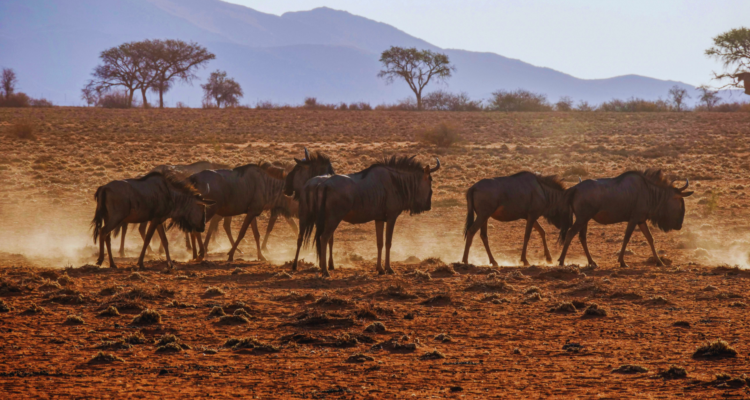
You’ve seen the cinematic slow-motion shots of wildebeest plunging into the crocodile-infested waters of the Mara. You’ve pictured yourself there, camera in hand, capturing the raw essence of the Great Migration. But here is the silent truth of many kenya safaris & tours: thousands of travelers spend ten hours a day sitting in a hot Land Cruiser, staring at a stationary herd that refuses to budge, only to leave empty-handed.
Witnessing a crossing during an african safari kenya isn’t just about being in the right place; it’s about understanding the “math of the move.” The Great Migration is a high-stakes game of survival, and the wildebeest don’t play by a tourist’s schedule. They play by the laws of pressure, thirst, and predatory presence.
If you want to stop guessing and start witnessing, you need to look at the data. Based on our 10-year logbook of sightings in the Masai Mara, we’ve decoded the statistical peaks of when a crossing is most likely to occur. This is how you optimize your time for the ultimate safaris in kenya africa.
The Myth of the “Early Bird” Crossing
Standard safari protocol suggests leaving camp at 6:00 AM to “catch the action.” While this works for lions and leopards, it is often the wrong strategy for the Mara River. Our data shows that wildebeest are remarkably reluctant to cross in the shivering chill of dawn.
The Psychology of the Herd
Wildebeest are “pressure-driven” animals. They require a “critical mass” to build up at a crossing point before the collective panic outweighs the individual fear of crocodiles. This buildup takes time. In the early morning, the herds are typically grazing 1–3 kilometers away from the banks, slowly drifting toward the water as the sun rises.
Information Gain: The “Patience vs. Reward” Hourly Analysis
For a decade, our lead guides have logged the exact start times of major crossings (500+ animals). The results debunk the idea that crossings are random. They are heavily influenced by temperature and light.
Statistical Probability Matrix by Hour
| Time Window | Crossing Probability | Activity Level | Tactical Advice |
| 07:00 – 09:00 | 8% | Low | Use this time for predators; the herds are still grazing. |
| 09:00 – 11:00 | 22% | Building | Position near “Main Crossing” or “Lookout” points. |
| 11:00 – 14:00 | 45% | Peak | The Heat Trigger. Most crossings occur in this window. |
| 14:00 – 16:30 | 18% | Tapering | Secondary herds may follow a “lead” group. |
| 16:30 – 18:00 | 7% | Rapid Drop | High risk of predators; herds often retreat from the bank. |
Why 11:00 AM to 2:00 PM is the “Golden Window”
The 45% probability spike during the midday heat isn’t a coincidence. As the equatorial sun peaks, the “pressure” at the riverbanks reaches a breaking point for two reasons:
- Dehydration: The sheer heat makes the urge to reach the lush grass on the other side more desperate.
- Visibility: Wildebeest have notoriously poor eyesight. High overhead sun reduces shadows near the banks, giving the “brave” leaders a clearer view of potential crocodile snouts or lions hiding in the reeds.
The Strategy: Don’t rush back to camp for a hot lunch. Pack a “bush fridge” lunch and stay at the river. While other vehicles head back to the lodges, you’ll be positioned for the statistical peak of the day.
Tactical Field Intelligence: Increasing Your Odds
Beyond the clock, there are three physical indicators that a crossing is imminent. If you see these on your african safari kenya, do not leave.
1. The “Stringing” Effect
Watch the horizon. If the wildebeest are spread out in a “carpet” formation, they are grazing. If they suddenly begin to form long, single-file lines (stringing) heading toward the river, the “intent” has shifted. A crossing usually occurs within 45 to 90 minutes of a major stringing event.
2. Zebra Integration
Zebras are the “scouts” of the migration. They have better eyesight and higher intelligence than wildebeest. If you see zebras mixed into the front of the herd at the water’s edge, the probability of a crossing increases by nearly 30%. Zebras are often the ones to make the first move, and the wildebeest follow in a blind “lemming” rush.
3. The “False Start”
Wildebeest will often run down to the water, look at a crocodile, and sprint back up the bank in a cloud of dust. Most tourists think the event is over and drive away. This is a mistake. In 60% of cases, a “False Start” is followed by a successful crossing at the exact same spot within 30 minutes. The panic of the retreat actually increases the pressure for the next attempt.
Frequently Asked Questions
What is the best month for an African safari Kenya to see a crossing?
Statistically, August and September are the peak months. This is when the largest concentrations of the herd are squeezed into the Masai Mara. However, with shifting rain patterns, late July and early October are becoming increasingly viable “shoulder” windows.
Do crossings happen every day?
No. During the peak season, you might see five crossings in one day and then none for three days. This is why we recommend a minimum of four nights in the Masai Mara to ensure you catch at least one major event.
Can we predict which crossing point they will use?
Rangers and guides use the “point system.” There are about 10–12 recognized crossing points on the Mara River. We monitor which side of the river has the shortest grass; wildebeest will always aim for the “greener” side, helping us narrow down the likely points to 2 or 3 on any given day.
Is it dangerous for the animals?
Yes. It is estimated that thousands of wildebeest drown or are taken by crocodiles each year. It is a raw, emotional experience, and we advise travelers to be prepared for the “circle of life” in its most visceral form.